Finding Hope in Serving Others

“What can I do?”

“What do I have to do?”

We’re called upon quite often to help others. Our innate asks and answers the call to help before our spoken words have the chance to leave our tongue.

Which question does your innate summon?

Which question do you speak?

Service, simply, is helping others. Service is not what we do for others, but what we give to others.

In the latter part of Romans, Paul outlines what service can look like for a Christian seeking to walk as the Lord would have them walk. Starting with Chapter 12, we see a shift in Paul’s tone from instructing us on how we should live to a tone of giving us his counsel and encouragement in applying what he has taught us. I interpret part of his exhortation to recognize that even though we are individuals, we are a part of something bigger. The choices we make are to be a contribution toward effectively living out our purpose as a member of the larger body. Life should no longer just be about us.

If service were about what we were doing for others, we would hold the upper hand or the power in the task (and maybe even some self-oriented pride in the outcome). When our mindset, our questions, our answers and our service are all about what we give to others, the upper hand and the power released is about something much greater than the one doing the service or even the one being served. It’s about the Spirit — about His ability to move within us, within others and within the world.

When we demand to be recognized or feel the need to point out what we’ve done just in case the other person missed it, is our service Godly service? When another is in need or we’re asked to provide a helping hand, is our nature to find a way to contribute or to check our schedule to find a way out of it?

When called upon to help, are our choices, words, actions, deeds AND thoughts, oriented toward God? or Self? Our innate answers before we do, and His grace gives us the power and reason summon a new answer.

Finding Hope in What is Promised

Heron.Romans828

“Within every crisis, there is a blessing.”

It’s a phrase I’ve been repeating to myself for more than 30 years. Anyone who knows me well has heard me say it. It’s how I’ve approached life since I was a teenager.

About 12 years ago or so, my young daughter handed me a new take on my old mantra. At that point, I had been a Believer for many years, but I was still in the very early stages of entering into a relationship with the Lord. She was challenged with something she was experiencing in her competitive athletics and was airing her frustrations in the car on the way home from practice one night. Trying to help, I used my mantra with her. It wasn’t the first time, but it was a time I will not forget.

I was looking at her in the rearview mirror sitting in the back seat. She looked at me through that mirror, and she said to me, “Mom, you know that’s kind-of in the Bible, don’t you?”

I had never considered my mantra biblical, but it was a part of my mostly-secular viewpoint that all things happen for a reason. Faith in being able to find a blessing was my perspective, but faith in the Lord through this phrase was not really a prominent part of my perspective at this point.

Intrigued by what my child was about to tell me, I said, “Really?”

She said, “Yes. You should read the book of Romans. That thing you always say is almost like Romans 8:28.” She proceeded to tell me that it said God will work everything for good for those who love Him.

My little girl was the reason we changed churches — she had so many questions that I couldn’t answer and our old church didn’t seem interested in helping to answer them. She was the reason I started to volunteer in the nursery during the youth ministry night at the new church. She was the reason I started attending the adult education class during the second service on Sunday mornings — so she could attend both church and Sunday school. She was the one who would excitedly share deep thoughts with me about what she was learning at this new church we were attending. Here was my little girl telling me that my mantra was in the Bible.

When we got home that night, the first thing I did after getting her some food, a shower and off to bed, was to go to my Bible. I really didn’t know where Romans was located within its pages, but thank goodness for a Table of Contents. I found Romans 8:28, and I read the words from my King James Version — a Bible which had been presented to me as a child from a Sunday School class, but which was hardly ever used:

“And we know that all things work together for good to them that love God, to them who are the called according to his purpose.”

The language was there. She was right. My mantra was actually in the Bible!

Wow! My mind started racing! A few months earlier, I had already decided to enter into this relationship which was different from anything I’d ever known before. I was excited about the teachings and messages I was hearing and learning at this new church. That night, though, was the moment I discovered that before MY mantra was MY mantra, it was His Word, and so many pieces of my life began to make sense to me.

He captured a piece of my heart as a little girl, and He never ever let go of me. Throughout the challenges of my childhood, the difficulties as a teen, the tumultuous college years, and the ups and downs of married life, He was always there. It was He who planted my mantra in me, and it was He who used my little girl to reveal Himself to me through His words that I’d been living by for so many years without even realizing that before they were my words, they were His.

Romans 8:28 has become my life-verse. The heart of this website has been built upon hopes surrendered to the Lord because of the deep promise that is found within this verse.

“The Message” version of Romans 8:28 states, “That’s why we can be so sure that every detail in our lives of love for God is worked into something good.”

Every detail. That’s such a promise. That promise can change hearts, change lives, change hopes, and change thoughts. Believe in it. Trust in the Lord.

Finding Hope in Honor

DSCF8171

He’s given us free will. Volition. Life’s choices are up to us.

Why do we struggle with them so much? Why do the choices seem so hard?

The world often comes at us with a set of choices different from where He might lead us in His Word. In reading His Word, we can be assured that it has always been this way. Despite our desire to imagine that life was easier in the “good old days,” those days — even back to Biblical civilizations — were full of struggles with life’s choices.

A few decades ago, the “What Would Jesus Do?” movement began. Bracelets and messages imprinted with “WWJD?” were everywhere and gave some of us pause before proceeding in our free will.

So how do we, as Believers, walk through our days today making the “right” choices? Everyone has a method. I’m not an expert on this subject, as I still struggle with it myself (what Believer doesn’t?), but I have my own WWJD method.

The last few years of my life have been rough ones. I’ve faced adversity, circumstances and choices I never could have imagined I’d have to face. My challenges are probably different from yours, but they are no more or less difficult in my life’s context as your challenges are in your life’s context. My journey of surrendering my hopes to the Lord has brought some of you into my life — some of you struggling with divorce, abuse, infertility, cancer, the death of a child or spouse, infidelity, depression, traumatic brain injury, miscarriage, rape, loss of purpose, bankruptcy, military injury and so much more.

Your struggle is valid. My struggle is valid. It is in our struggles that we can be defined, or we can be refined.

Psalm 66:10 says, “For you, God, tested us; you refined us like silver.”

I am one who believes that the possibility of refinement exists in the trials and tests we are allowed to experience. The positive or negative outcome from these tests is often determined by our perspective.

I don’t ask “WWJD?,” but I do challenge myself and hold myself to a standard that I try to meet in my free-will choices.

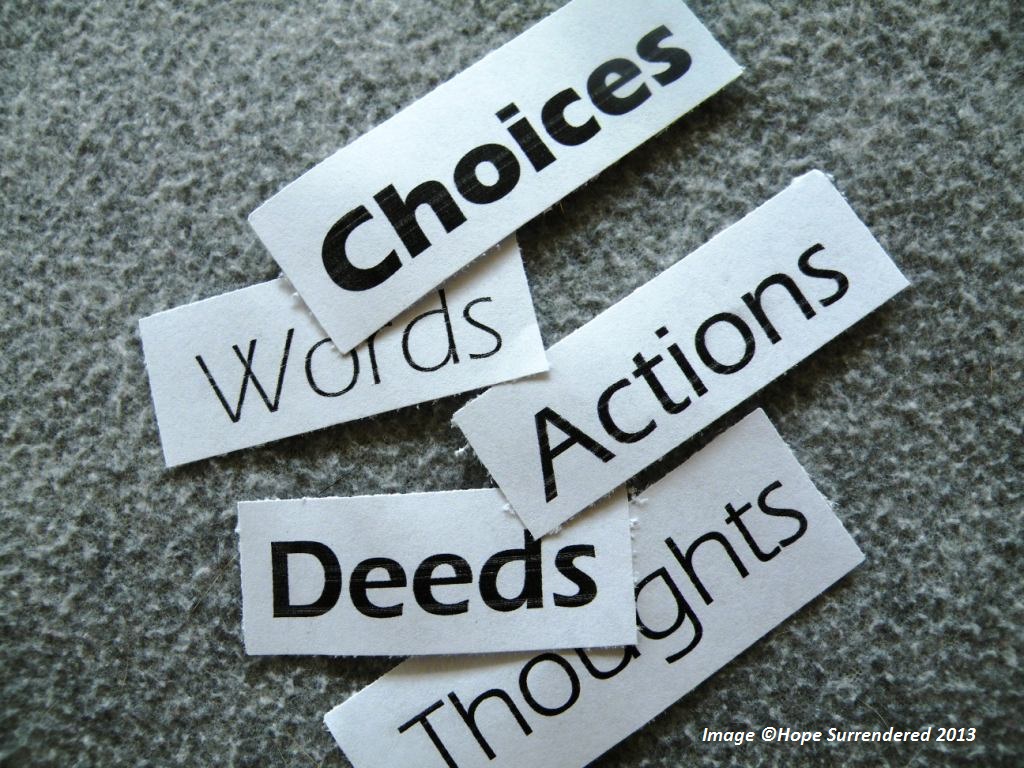
As I walk through my days, my struggles, my hopes, my sadness and my joys, I strive to be God-honoring in my choices, words, actions, and deeds. These four words…

      • choices
      • words
      • actions
      • deeds

…have been an instrumental part of the hope which has gotten me through the thousands of decisions I’ve had to wade through over my struggles of the last few years.

A few months ago, a mentor of mine challenged me to take it one more step. He suggested that I add “thoughts.”

Profound.

Very profound.

I added it.

So today, my list, my method, my goal, my lifestyle attempt is:

To prayerfully be God-honoring in my choices, words, actions, deeds and thoughts.

Oh, what a blessing has been produced by being refined on His terms and in His timing!

Finding Hope in the Healing

Where is He?

God is present in our hurting. In the depth of our struggle, we don’t always understand how it is that He can allow our hurts.

God is also present in our healing. We often do choose to give Him credit for the healing.

But, where is He when we are at the in-between? When we are taking forward steps and sliding backward in our healing from the hurt, is He there? Do we allow Him to be there to walk with us and lead us along His path?

It is there — at the in-between times — in which we spend so much of our time. The hurt is done. It has forever changed us. We know that we need to move on — to move away from the hurt — yet we keep reliving that pain. This is where we dwell for far too long.

Is He with us when we dwell here? Why do we allow Him in only when we want to ask, “why?” or “why not?” Why do we allow Him to be with us, momentarily, when we want to scold Him for allowing this pain? Why do we often shut Him out?

When we choose to allow Him to be with us every step of the way, we will know from where HOPE comes. We will see His tenderness, His love, His tears shed for our pain, His ways of working our pain toward healing, His hand of protection keeping us from what could have been worse. We will see all of it when we allow Him to be with us.

There is a beautiful worship song called, “Everything” that is sung by Tim Hughes. The song provides a wealth of reflection when sung, when spoken, when studied and when prayed.

Some of the lyrics of this song are:

 “…God in my hoping, there in my dreaming

God in my watching, God in my waiting

God in my laughing, there in my weeping

God in my hurting, God in my healing

Be my everything…

…Christ in me, the hope of glory

You are everything…

…Be my everything…”            

When He is our Everything, we will heal.

___________________________________________________________________

Note:  If you’d like to hear Tim Hughes discuss his song mentioned above, you can do so here:  http://www.praisecharts.com/tim-hughes-discusses-and-sings-his-song-everything-/

Finding Hope through the Temptation

Fire.Temptation - Copy

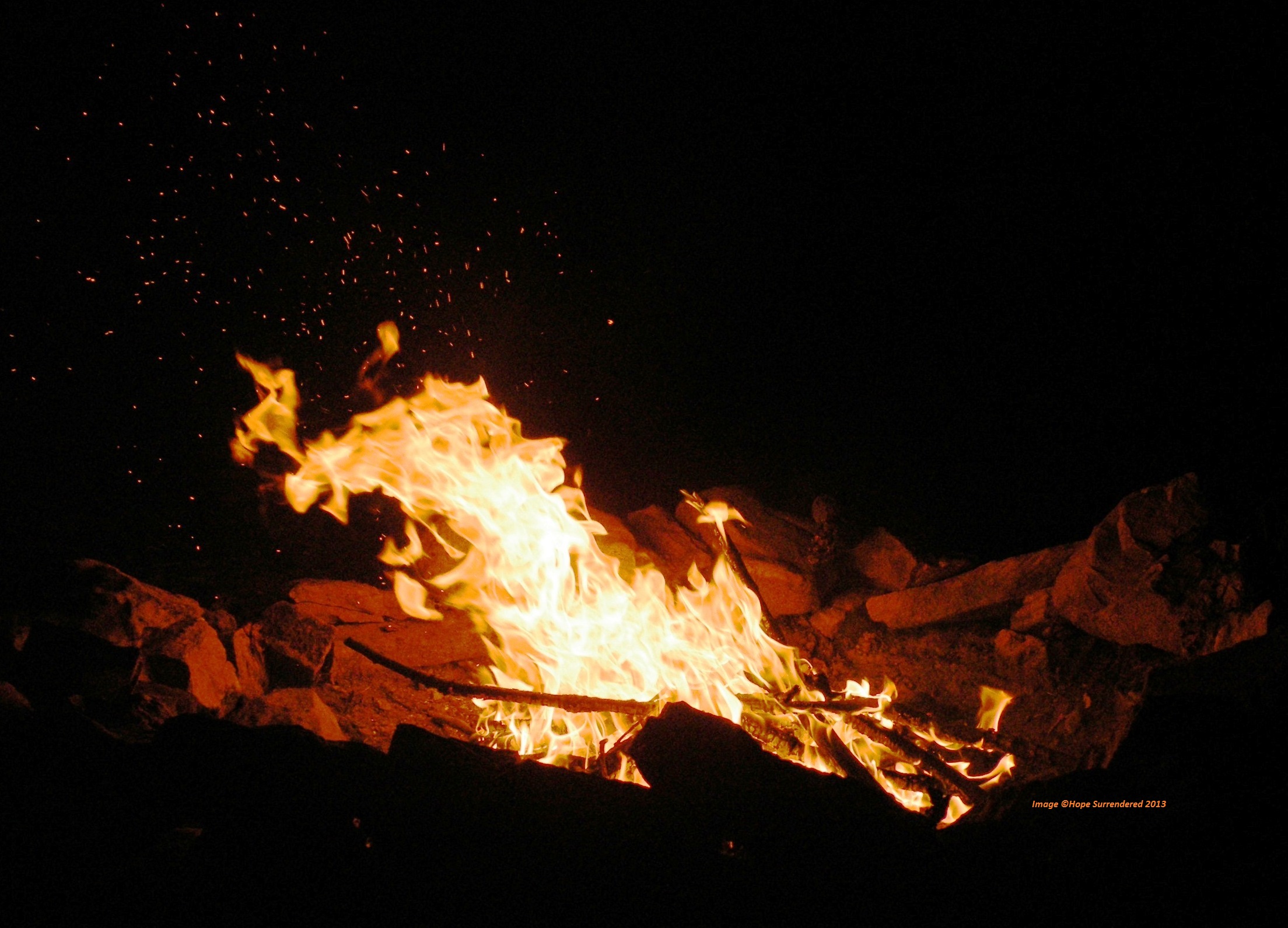
A few nights ago, I made a fire in the outdoor firepit. Why is it that when you WANT to start a fire, it’s often a challenge to get it going with the newspaper and tinder teepee? People have accidentally burned down their home by smoking in bed or playing with matches, but when you want to get a campfire going, it can be tough!

In any case, I finally did get it going. As I watched the flames slowly build and consume the dry wood, I had some time to reflect. As beautiful as the fire was, my mind was drawn to sin and how it often can consume us if we are not careful.

The wood I used was dry, but not too old. It was a soft wood — not the best for burning in a fire, but it was what I had on-hand after losing some branches to a storm last fall. The bark was still intact, and I could tell there was still a great deal of moisture left in the heart of the wood, as the smoke was thick and pungent, and it took a while for the wood to actually start to burn.

Sin can be like that for us:  it can take some time until we start to burn under the temptation. When we’re a Believer walking with the Lord, we’re not always the easiest target for the prowling lion to devour, but when we suffer some kind of loss or spiritual test of our will, we can be weakened.

That prowling lion is always ready to pounce. He watches for our weaknesses.

When we’re put into the flame, it often takes some time until we give into the sin. We choose to stay in the Word, we spend time in prayer, we ask others to pray for us, and we remind ourselves about the path we are supposed to be on, but if we aren’t careful, we can be slowly overtaken by the sin — much like the wood can be overtaken by the flames.

A fire, when it has fuel, will grow.

Sin, when it has fuel, will grow.

The flames dance around as they change the still-fresh, bark-covered wood into an ashen-covered char. We dance around our temptations. We justify them, and we justify why we can handle them — because we are Believers.

Eventually, the glow of blue, orange, yellow and red takes over the wood, and a seething-hot bed of coals begins to form beneath the wood that stands little chance of survival. For us, we can eventually be worn down from the temptations, from the worldly viewpoint, from our challenges and justifications. Sin provides us with a distraction, a place where we can be different, a place where we can fit in — this is our bed of coals. It is here that we stand little chance to escape unharmed and unchanged.

A dancing fire. An enticing sin.

In 1 Corinthians 10:13, we are told:

“No temptation has overtaken you
except what is common to humanity.
God is faithful,
and He will not allow you to be tempted beyond what you are able,
but with the temptation
He will also provide a way of escape
so that you are able to bear it.” (HCSB)

The hope is in the Word. It’s in knowing that there is always a way of escape. Watch those flames!