A friend of mine recently crossed through a milestone moment — the anniversary of the death of her husband.
There’s no shirking the emotions that milestones like this bring about.Three years into her life change is nothing to gloss over, nothing to forget, nothing to celebrate …
… but there has been …
The lost days, the altered plans and the shattered dreams are beginning to yield to the blooming opportunities, new days and optimism she’s finding as she steps out of the losses and toward her new hopes. She’s grown, she’s gotten stronger, and she’s marking her milestone memories with plans for an unknown-yet-hope-filled future. That’s something to celebrate, even if the milestone moments and losses are not.
We all have these milestone moments. All of us. They are those days on the calendar or in our heart that cause us to withdraw and just think. They are our “would’a, should’a, could’a” moments that will always be a part of us.
But it’s what we do with them that counts toward our joy and our internal peace.
When we are walking through them knowing that the hard losses can still help us find our way to a future of something bigger … well, it’s then that our milestone moments are worked for good.
I’ve written before about how someone I care deeply about is locked behind the walls and the concertina wire of prison. (You can read about that here)
While visiting with him this weekend, grace tapped on my shoulder.
At this facility, visitation (after the stringent security search, the full-body pat down, and the K-9 sniff test for the visitors, and the complete strip search for the inmate) means hugs and kisses upon arrival and departure, and it means cherishing the opportunity to sit in the presence of your loved ones (it’s worth every bit of inconvenience). There were aging parents visiting their sons, tired moms with toddlers visiting their children’s’ father, a teenaged boy laughing with his dad while playing a smack-down game of UNO, and a young momma who had brought her newborn to visit with his daddy.
The people in the room were here for different reasons. They were there to share a few hours with loved ones, trying to maintain relationships, trying to imagine the future together, or working out life’s inside-outside and outside-in differences.
Prison is hard.
It’s hard for the inmate, and it’s hard for the family of that inmate. You may have heard otherwise about prison, but, unless you have experienced it personally or lived the life that comes with loving someone on the inside, you have absolutely no idea …
Yesterday, in that prison visitation room, grace tapped on my shoulder.
As a woman was readying to leave the visitation room at the end of her visit, she approached my chair from behind and tapped me on the shoulder. She was with a man and two boys who appeared to be middle schoolers. Visitors are allowed to speak with other visitors; inmates are allowed to speak with other inmates. Visitors, however, are not supposed to speak with inmates, other than the one they are visiting, and inmates are not supposed to speak with visitors, other than those visiting them.
She tapped me on my shoulder and “whispered” loud enough for the others at my table to hear:
“He was my [doctor] for many years.
He helped me so much.
He changed my son’s life.
My son was plagued with ear infections
until we brought him there, and with all
he taught us and showed us, my son, who is now 11,
only ever had one ear infection after that.
He was such a good [doctor].”
The man I was visiting used to be a doctor. He’ll always be one, but he just doesn’t hold any licenses to practice anymore. The likelihood of him ever being able to practice again is very slim. It was his passion, and it was a part of his purpose for a long season of his life.
With the comments from this woman, his face grew white, and his entire mood changed. I saw regrets, sorrow, embarrassment and devastation in his eyes.
I took a deep breath, and so did he. I asked him if he remembered her. He was flustered and didn’t want to answer. He couldn’t remember her name, but he eventually did say that he did remember her.
I asked him if he was ok.
He said he was, but his demeanor didn’t affirm this.
“You know,” I said, “that was so kind of her to stop and say what she said. She could have just ignored us from across the room and never said a thing as she was leaving. She took a moment to come over to let you know how you have impacted her life. What a gracious thing for her to do.”
He nodded in agreement, as tears started to fill the corners of his eyes.
Grace.
Unmerited favor;
Finding favor toward another;
Offering that which is often undeserved;
Love in action.
When I arrived home a few hours after my visit, the phone rang. The caller ID let me know that an inmate call was coming through the line.
He called to tell me he had just gotten back from church, and that instead of napping on his cot in the 90-degree, un-airconditioned cell block during the afternoon between our visit and church, he spent some time in prayer and reflection about this woman’s words to me following her tap on my shoulder.
He apologized to me, saying he “sucked thumb” and sulked for a while after we left, but he had come to the conclusion that he appreciated his former patient’s willingness to share the impact he had made in her life during his own past life and career. In his reflection time, he was able to remember the thousands of people he had helped over nearly 20 years of doctoring, and he was grateful for the people he had met along the way. He had decided that her words were going to serve as a positive reminder of his former season of life, rather than be a stinging reminder of what he didn’t have anymore.
And then he said it: “She didn’t have to do that, but she did.
That was grace in action.”
Yes.
Yes, it was.
It was grace in action. Grace brought on by a tap on the shoulder at a prison visitation.
I have a friend who is fighting a tough battle with cancer, and today she has a new appointment with a new doctor in a new place for a new round of hope in her future.
I often don’t know what to say to someone else who is fighting a battle, but it’s just in my God-given nature (truly, not of my natural self) to pray that people never give up hope. So, I do.
Wondering hope leaves us wondering. Expectant hope leaves us expecting.
There’s a huge difference between these kinds of hopes, and my prayer is that she can find even more expectant hope through her trial—more than she’s already had to muster up in all phases of this years-long journey.
“Expectant hope is powerful and never wasted.”
Those were some of the words I shared with her this morning as she reached out to her friends on social media before her appointment.
Wondering hope leaves us wondering. Expectant hope leaves us expecting.
My encouragement to you today (and it’s a needed encouragement to my own self-talk, too), is to stop wondering and start expecting. Expectant hope is powerful and never wasted, especially when you stop hoping in the circumstance, and begin hoping in That which is greater than the circumstance.
May was a magnificent month on so many levels. May brought sad endings, happy endings, fresh starts and new beginnings on my path throughout the month. Memories were made through milestone moments, love was shared and doors were opened.
May was also a tough month. Doors slammed closed on yet another round of hope, justice fell through a manipulative chasm, and loneliness ensued within a black hole of solitude.
June is here, and a new month is a new opportunity to mark a new round of optimism and hope … by choice, of course.
It is a choice. It’s always a choice.
Within every given ending, start, beginning, milestone, anniversary, reminder, closed door, chasm
or black hole of circumstances, hope is a choice.
Do you hear that? Hope … it’s a choice.
It’s a choice you have to make, and it’s a choice I have to make, too.
Don’t ever give up on it.
Don’t ever let the darkness overcome the light.
Don’t ever …
Choose hope.
May the God of hope
fill you with all joy and peace
as you trust in him,
so that you may overflow with hope
by the power of the Holy Spirit.
~Romans 15:13 (NIV)
What is your hope for June? What is the darkness needing to be overcome by the light? I’d like to pray for you, and I’d certainly appreciate your prayers for me, too.
May you find yourself reflecting on what’s He’s done. This post is a more recent take on one done a few years ago about what today brings and how the death of a Friday can mean so much in our lives.
Good Friday. It’s a rainy morning here in rural Appalachia, and it seems fitting for the day Christians around the world mark as one of death and darkness.
… To be beaten, flogged and scourged with a barbed whip until nearly unrecognizable; … To have a crown of thorns pressed into my head; … To be nailed to a tree with spikes through my wrists and feet; … To die by crucifixion alongside common criminals …
No. None of this, I’ve imagined, could be good if I would have to experience it.
I haven’t had to, but I know Jesus has experienced it all.
How could it be that we’d wind up called this a “good” kind of Friday when He had to go through such incredible torture?
It’s about 8 a.m., and I’m sipping my coffee while still in my pajamas and fuzzy slippers. I’m reflecting on the ups and downs and the clarity and confusion over the years in my own journey of faith. I’m also reflecting on what must have been going on more than 2000 years ago. My comfort of today makes me feel uncomfortable in comparison to what He must have been going through in these moments.
It will be 9 a.m. soon …
Jesus was nailed to the cross in the morning at about 9 a.m.** after enduring questioning, a trial and brutal beatings.
Once that cross was set into place, He hung there until noon**, at which point the skies overhead darkened.
I don’t know if it was a rainy day on the hill of Golgotha that morning in Jerusalem as it is here in the hills of Appalachia, but I have a feeling it wasn’t. God often allows us to see great contrasts in revealing His will for our lives, and that tends to make me think it was a sunny day in Jerusalem.
The darkness lasted for three hours, and around 3 p.m.**, Jesus cried out amid His suffering and suffocation to proclaim, “Tetelestai!” before giving up his spirit and breath of life.
It was finished.
Done. Over. Death.
Most of us automatically equate the “it is finished” to His life, since, just moments afterward, His life was over on this particular Friday afternoon – the day we commemorate in remembrance as “Good Friday.” However, the “it is finished!” was much more than just a part of the final words he uttered in the final moments of His life before giving over his life and spirit.
The “it is finished!” was His “paid in full” proclamation regarding our sin.
He paid the ultimate price by taking the sins of all mankind – the past, present and future sins of the past, present and future mankind – upon himself and shedding His own blood to redeem us in exchange for Himself. The ransom price was paid, and the salvation plan was now complete. He had completed the will of God and the will of the Father.
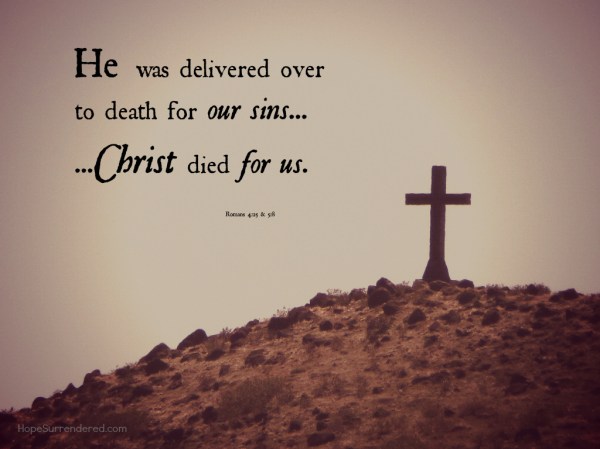
That’s where the “Good” comes in. He suffered for us. He demonstrated his self-sacrificing love for us and for our wrongdoings by dying for us (Romans 5:8). What He did for us once does not have to be repeated by all of us (1 Peter 3:18) in order for us to live eternally in His presence (John 3:16).
For the longest time, I didn’t understand how His death could be “good” and recognized as “Good Friday.” I knew He died for us, but I guess I just didn’t fully grasp that He died for ME.
Almost 15 years ago, I went to a new church. On my first visit to this church there was a song sung which stood out to me. I didn’t know it, so I didn’t sing it. I just listened.
There can be such power in doing that once in a while.
I didn’t understand what the words meant, but that song awakened something within me.
The song was Above All. The words which resonated with me were:
“… crucified, laid behind the stone.” I understood this.
“… lived to die, rejected and alone.” What did this mean?
Ok, He died on that cross, but what did it mean that he “lived to die?”
“… You took the fall and thought of me above all.”
Me? Me?!? What did that mean?
What did I have to do with what He did? I didn’t get it, but I was curious.
I’ll never forget those words. Even today, they still hold meaning to me. It’s like the stone of death and darkness was rolled away in my own life in some of those moments. An awakening within me had begun. I had come to that new church with questions, but now – after only one visit – there was an even bigger question burning within my mind … and in my heart. It was one that would lead to knowing what He did for ME, and one that would lead to me knowing HIM personally.
That’s what is good about Good Friday.
He died for US.
He died for ME.
If He died for us, and if He died for me, then he also died for YOU.
That’s what is good about Good Friday.
There’s a hope to be found, a purpose for this life, and a plan for your future. It’s all a part of the “good” in what was done for us. If you know the story, but you don’t know Jesus in a very personal way, I encourage you to take some time today to reflect on these thoughts and to think about them.
I then encourage you to reach out to THAT friend you have … you know who I mean … the one who has been living a life of expectant hope … the one who seems like she gets this … the one who has been gently loving you while trying to help you see a different way … Yes, her. Reach out to her on this Good day of Friday, and let her know what you are thinking.
He also died for you. That’s what is good about Good Friday.
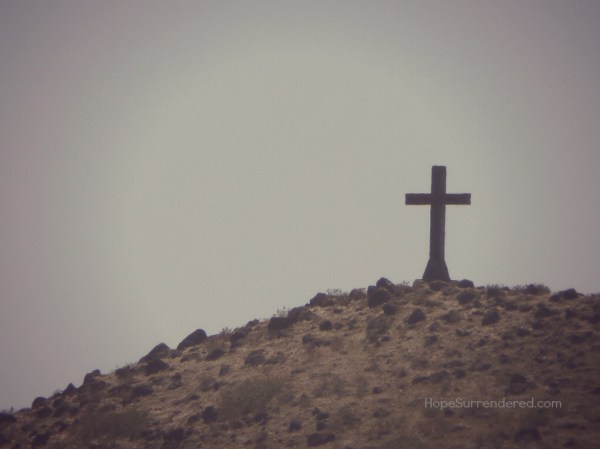
Photo taken on a rubbled hill in Costa Rica
_____________________________________________
**Notes about the times of day:
The Gospel of Mark uses “the third hour” to designate when Jesus was crucified or put on the cross. This would have been 9 a.m. (Mark 15:25). Mark then goes on to say that at “the sixth hour,” darkness came over the land (Mark 15:33). This would be noon or 12 p.m. In Mark 15:34, we are told that Jesus cried out in the ninth hour, at 3 p.m., and then, shortly afterwards, took his last breath (Mark 15:37).
The Gospels of Matthew and Luke use similar time designations (see Matthew 27:45 and Luke 23:44). This way of calculating time was based on the Jewish method, where 6 a.m. would have been the first hour of the day, so noon would have been the sixth hour and 3 p.m. would have been the ninth hour.
It is believed the Gospel of John, which presents a different time for the start of the crucifixion, used a Roman method of time calculation, which would have started the day at midnight (John 19:14). There could have, however, been a three-hour period of time between his sentencing before Pilate (sixth hour) and time Jesus spent under the charge of the soldiers, time spent carrying his cross (John 19:17) and arriving at Golgotha where the crucifixion took place.
Various commentaries show a consistency in these interpretations of time. I’ve used Sonic Light, The Bible Knowledge Commentary, and Got Questions for my sources in this post.


 Hope Surrendered