The Worthless Pursuit of More and More

CT.3-4
Photo and artwork belong to ComparisonTrap.org

This is the continuation of an earlier post about a Bible study in which I’m facilitating and participating.


Then he said to them, “Watch out!
Be on your guard against all kinds of greed;
a man’s life does not consist in the
abundance of his possessions.”
~ Luke 12:15

The Comparison Trap:  Week Three, Day Four … Some of my reminders and my takeaways from the daily devotional include:

“We live in a world of accumulation,” begins Sandra.

We do. We crave abundance, and it’s almost scary how often we can catch ourselves thinking of more, more, more.

Sandra goes on to share the verses after the Scripture above. It’s a parable told by Jesus in Luke 12:16-21:

“The ground of a certain rich man yielded an abundant harvest.   17 He thought to himself, ‘What shall I do? I have no place to store my crops.’  18 Then he said, ‘This is what I’ll do. I will tear down my barns and build bigger ones, and there I will store my surplus grain.   19 And I’ll say to myself, “You have plenty of grain laid up for many years. Take life easy; eat, drink and be merry.”’  20 But God said to him, ‘You fool! This very night your life will be demanded from you. Then who will get what you have prepared for yourself?  21 This is how it will be with whoever stores up things for themselves but is not rich toward God.’”

There are a few things to note from this parable, outside of the obvious sense of greed and desire to have more:

  • Verse 16 tells us the man was rich and yielded an abundant harvest while he was rich. Apparently, God had blessed the man. Whether or not the man was a “good” man is irrelevant; God had still given him a gift in the form of abundance.
  • Verse 18 tells us what was said by the man. Do we read of him giving thanks?  Of acknowledging God for the abundance given to him?
  • Verse 19 tells us what the man desired from his abundance. Does this show his desire to live for God?  For others?  Or only for himself?
  • Verse 20 gives us some of the answers to these questions. God calls him a fool. Just in case you are wondering … fool basically means fool in the original language. God wasn’t impressed with what the man decided to do with the blessings God had allowed the man to accumulate.

Sandra’s devotional Challenge for Day Four was to mark some boxes designating some of our abundance.
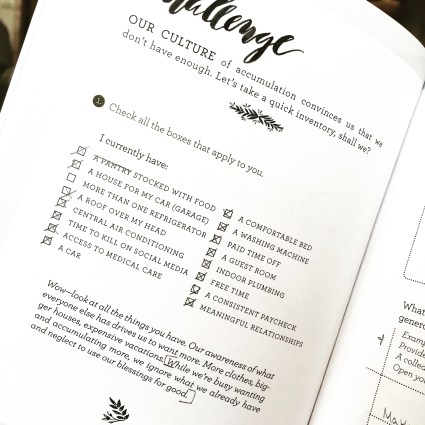
CT.3-4.1
The boxes I checked in the Day Four Challenge

I’ve visited countries where having just ONE of these line items would be living luxuriously. Some of you have lived in or served in places like that, too. Even so, the trap of comparison keeps us wanting more, doesn’t it?

We’ve been given the blessings in our lives for a reason.

We need to work harder on appreciating those blessings and using them for His purposes, as God often says something different to us than what we are willing to say to ourselves. The richness, wealth and abundance of life does not have to equate to the amount of property, the dollars in our bank account, or the possessions we tend to hold valuable.

“The accumulation of more is a worthless pursuit if what you are accumulating isn’t put to good use for God.”

The material possessions we seek and acquire can’t ever fully satisfy us in comparison to an intimate relationship with God. When we’ve been blessed by Him, it’s imperative that we focus on Him and on how He would call us to use those blessings. Let’s not be a fool.


Dressing Up My Selfish Ambitions

CR.1-7
Photo and artwork belong to ComparisonTrap.org

This is a continuation of a previous post about a Bible study in which I’m facilitating and participating.


But if you harbor bitter envy and selfish ambition in your hearts,
do not boast about it or deny the truth.
~ James 3:14

The Comparison Trap:  Week One, Day Seven … Some of my reminders and my takeaways from the daily devotional include:

“I quit.
Mom, I am done.
Please don’t make me go back there.
I don’t want to do it anymore.
Please, Mom.
Please!”

We went through this a lot. My daughter was probably about 10 or 11, and she was an award-winning drama queen when it came to the ups and downs of gymnastics. This was the umpteenth time I’d heard it by this point, and there was just NO WAY I was going to let her quit.

“I know she loves her sport; it’s just tough to learn that new skill.”
“Her negative coaches don’t help matters, either.”
“It just seems easier for her to quit than it is to go back into that gym, to push through the mental challenges, to force her body to do something it isn’t naturally gifted to do, and to deal with their continual ‘you’ll never be good enough’ projections.”

This is what I’d tell myself all the time.

Similar to many of you reading this, I approached sports from the perspective that quitting is something you just don’t do. There may come a time when participation has run its course, but one just doesn’t quit.

“… especially my daughter.”

My not wanting her to quit when things got tough was mostly about teaching her hard lessons, but I do admit:  Part of the reason I didn’t want her to walk away during these emotionally charged times was because it wouldn’t make me look good, either.

“What kind of parent allows her child to quit gymnastics over THAT?”
I regularly asked myself this question.
“Only a not-so-good one …”  is what I’d tell myself.
“… Only one who wasn’t completely dedicated to helping their daughter reach their potential …”
I sounded so smart to myself.

The fear of wondering what others would think was part of the reason I’d spend the 40-minute car ride home convincing her that everything would be ok, and that things would look different in the morning.

They did. She was usually ready to head right back into the gym, and I didn’t have to tell anyone that we were leaving the gym and quitting. I was pretty good at dressing up my semi-selfish ambitions.


NOTE:  She stuck with it for 13 years, reached Level 10, and was an all-around champion in our state many years in a row. Gymnastics did, though, run its course due to a devastating injury. She didn’t quit; she walked away because it was what she knew needed to do at that point in her life. Through two seasons in a wheelchair and a struggle to heal her injuries, her mind and her body, she reprioritized her focus on the sport and made her way back into the gym as a coach. She became a coach who worked to inspire young gymnasts, and she was a coach who helped parents understand the ups and downs their daughters experience in the sport. She was the one who looked good, and she was the one who pushed herself to success. Today, she’s a police officer serving her community. I celebrate her joy with her today, and today, it’s not at all about me.