The Worthless Pursuit of More and More

CT.3-4
Photo and artwork belong to ComparisonTrap.org

This is the continuation of an earlier post about a Bible study in which I’m facilitating and participating.


Then he said to them, “Watch out!
Be on your guard against all kinds of greed;
a man’s life does not consist in the
abundance of his possessions.”
~ Luke 12:15

The Comparison Trap:  Week Three, Day Four … Some of my reminders and my takeaways from the daily devotional include:

“We live in a world of accumulation,” begins Sandra.

We do. We crave abundance, and it’s almost scary how often we can catch ourselves thinking of more, more, more.

Sandra goes on to share the verses after the Scripture above. It’s a parable told by Jesus in Luke 12:16-21:

“The ground of a certain rich man yielded an abundant harvest.   17 He thought to himself, ‘What shall I do? I have no place to store my crops.’  18 Then he said, ‘This is what I’ll do. I will tear down my barns and build bigger ones, and there I will store my surplus grain.   19 And I’ll say to myself, “You have plenty of grain laid up for many years. Take life easy; eat, drink and be merry.”’  20 But God said to him, ‘You fool! This very night your life will be demanded from you. Then who will get what you have prepared for yourself?  21 This is how it will be with whoever stores up things for themselves but is not rich toward God.’”

There are a few things to note from this parable, outside of the obvious sense of greed and desire to have more:

  • Verse 16 tells us the man was rich and yielded an abundant harvest while he was rich. Apparently, God had blessed the man. Whether or not the man was a “good” man is irrelevant; God had still given him a gift in the form of abundance.
  • Verse 18 tells us what was said by the man. Do we read of him giving thanks?  Of acknowledging God for the abundance given to him?
  • Verse 19 tells us what the man desired from his abundance. Does this show his desire to live for God?  For others?  Or only for himself?
  • Verse 20 gives us some of the answers to these questions. God calls him a fool. Just in case you are wondering … fool basically means fool in the original language. God wasn’t impressed with what the man decided to do with the blessings God had allowed the man to accumulate.

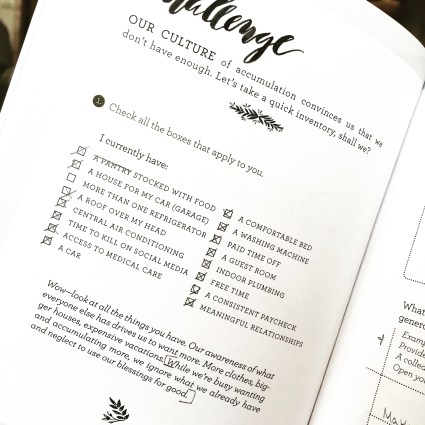
Sandra’s devotional Challenge for Day Four was to mark some boxes designating some of our abundance.
CT.3-4.1
The boxes I checked in the Day Four Challenge

I’ve visited countries where having just ONE of these line items would be living luxuriously. Some of you have lived in or served in places like that, too. Even so, the trap of comparison keeps us wanting more, doesn’t it?

We’ve been given the blessings in our lives for a reason.

We need to work harder on appreciating those blessings and using them for His purposes, as God often says something different to us than what we are willing to say to ourselves. The richness, wealth and abundance of life does not have to equate to the amount of property, the dollars in our bank account, or the possessions we tend to hold valuable.

“The accumulation of more is a worthless pursuit if what you are accumulating isn’t put to good use for God.”

The material possessions we seek and acquire can’t ever fully satisfy us in comparison to an intimate relationship with God. When we’ve been blessed by Him, it’s imperative that we focus on Him and on how He would call us to use those blessings. Let’s not be a fool.


Seeing Broken Bits Multiplied into Blessings

CT.3-3
Photo and artwork belong to ComparisonTrap.org

This is the continuation of an earlier post about a Bible study in which I’m facilitating and participating.


Andrew spoke up, “Here is a boy with five small
barley loaves and two small fish,
but how far will they go among so many?”
Jesus said, “Have the people sit down.”
There was plenty of grass in that place, and they
sat down (about five thousand men were there).
Jesus then took the loaves, gave thanks,
and distributed to those who were seated
as much as they wanted.
He did the same with the fish.
When they had all had enough to eat,
he said to his disciples, “Gather the pieces that are
left over. Let nothing be wasted.”
So they gathered them and filled twelve baskets
with the pieces of the five barley loaves
left over by those who had eaten.
~ John 6:8-13

The Comparison Trap:  Week Three, Day Three … Some of my reminders and my takeaways from the daily devotional include:

For me, this is one of the most powerful devotions in the Comparison Trap study, so far.

I’ve been going through some things in my life … things that are uncomfortable, and circumstances which have pushed me to limits I didn’t know I had. I find hope in the Scripture above, even though the expectant hope and personal application I’ve found in it is somewhat outside the context of the verses.

Here are the three things that stand out the most to me:

  1. “Here is a boy …”  He’s a boy. Not a pastor, teacher, businessman, or anyone who might stand out to others. He’s a boy.
  2. “Let nothing be wasted …,” said Jesus. I’ve always known He told the disciples to gather what remained, but I’ve never consciously read those words to the point that they’d stand out, even though my study Bible is an older New International Version (the same as the Scripture above).
  3. God provides, and He turns what we have to offer Him into blessings.

So here are my main takeaways from the three aspects that stand out to me:

  1. I am the boy. You are the boy. Whatever we have to offer Him, he can use. Am I willing to recognize that even a small offering can be a blessing? That He can use it for the good of others? That my faith can grow when I am willing to share the gifts He’s given me?
  2. God wastes nothing.  I’ve said this so many times to myself, and I’ve written about it, too. Yesterday, in a weepy breakdown, I just kept repeating this over and over to myself, and here it is in the Scripture today. He’s going to create a way for the broken bits and pieces of my life to be multiplied, shared, and gathered, because He is the One who commands that nothing be wasted.
  3. He’s ready to multiply my faith and turn it into blessings for me and for others. We don’t know the attitude of the boy who offered up his lunch, but we do know what was done with it. I need to keep reminding myself that this life isn’t just about me and my weepy circumstances; it’s about how He can and will use those circumstances for His good if I’m willing to lay them at His feet.

Sandra Stanley asks, “What did it do to the boy’s faith to watch Jesus turn his small offering into a blessing for so many others? What could it do to your faith to watch God do the same with what you can offer?”

She goes on to encourage us to fight the feelings that our little bits could never go far enough, and to instead, trust God to make our bits astoundingly more — immeasurably more, even.

In my weepy moments and in my joyous ones, it’s important for me to remember that He commands nothing be wasted, and that what I have IS less important than what I do with what I have. The impact is made when I’m willing to offer up what I have for Him to use.


Coming Out on Top in One-upmanship

CT.3-2
Photo and artwork belong to ComparisonTrap.org

This is the continuation of an earlier post about a Bible study in which I’m facilitating and participating.


Let us not become conceited,
or provoke one another,
or be jealous of one another.
~ Galatians 5:26

The Comparison Trap:  Week Three, Day Two … Some of my reminders and my takeaways from the daily devotional include:

We just finished talking about the fruit of the spirit in Galatians 5, and here, just a few verses later, we’re cautioned in reference to one-upmanship.

This is the really ugly part of the comparison trap.

“Well, at least my marriage isn’t like that …”
“I’m SO grateful my child didn’t turn out like hers.”
“My husband might have issues, but at least he didn’t do that.”
“I deserve the promotion over her, because I work harder.”

Pretty ugly, isn’t it?

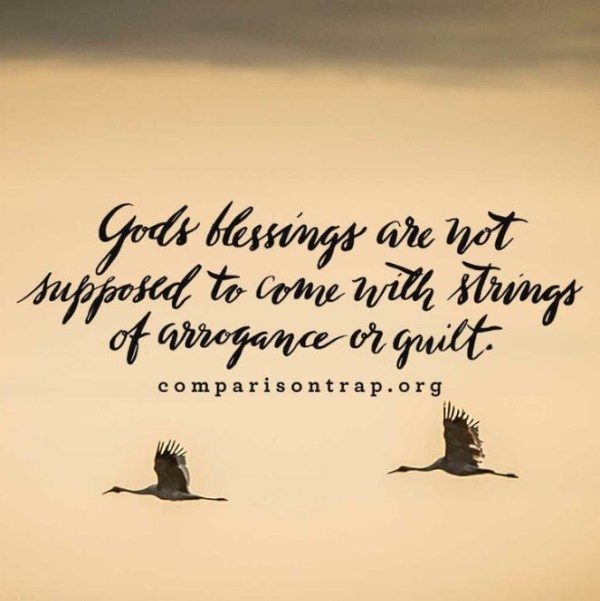
“Coming out on top in comparison’s game can lead you to conceit, arrogance and pride,” says Sandra. She then reminds us that “God’s blessings are not supposed to come with strings of arrogance or guilt attached.”

We did just get finished reading an impactful devotion about the fruit of the Spirit yesterday, didn’t we? It might be time for a brief review already, because if you are anything like me, you may not have said some of those phrases above, but you’ve probably thought them (are you willing to admit it?).

In his commentary on Galatians, Dr. Tom Constable makes a suggestion:

“Rather than trying to remove all of our former sinful practices ourselves, we should cultivate the spiritual life, and the Holy Spirit will deal with them.”

He goes on to categorize the fruit of the spirit, defining the characteristics based on their word origins in the original Greek language like this:

Mental or God-ward qualities
“Love” (Gr. agape, self-sacrificing affection for others)
“Joy” (Gr. chara, deep-seated gladness regardless of circumstances)
“Peace” (Gr. eirene, inner quietness and repose regardless of circumstances)

Interpersonal or other-ward qualities 
“Patience” (Gr. makrothymia, forbearance even under provocation)
“Kindness” (Gr. chrestotes, benevolence and graciousness)
“Goodness” (Gr. agathosyne, constructive action reaching out to others)

General or self-ward qualities 
“Faithfulness” (Gr. pistis, reliability, trustworthiness)
“Gentleness” (Gr. praytes, acquiescence to authority and consideration of others)
“Self-control” (Gr. enkrateia, ability to master oneself)

When we read through these definitions of what a Spirit-filled life can look like, we don’t associate “ugly” with these words. 

Sandra goes on to remind us that the fruit of the spirit sounds like the exact opposite of the conceit and jealousy we’re warned about in today’s Scripture verse — just a few verses afterward. She says, “To steward God’s blessings well, we just need to display outwardly the qualities of the Spirit that already live inside us.”  

If you are a Christian, then ALL of these qualities do live within you.

Conceit, arrogance and pride also live within us, but when we’re willing to yield to the Spirit, He will steward His blessings very faithfully.


When Fruit Grows, Comparisons Don’t

CT.3-1
Photo and artwork belong to ComparisonTrap.org

This is the continuation of an earlier post about a Bible study in which I’m facilitating and participating.


The Comparison Trap:  Week Three, Day One … Some of my reminders and my takeaways from the daily devotional include:

Our study group came back together for our weekly gathering at the end of Week 2 and kicked off Week 3 with Andy Stanley’s teaching on the parable of the talents from Matthew 25. He asked us to consider ourself as a “two-bagger” in relation to the parable and our study in the Comparison Trap, noting that there will always be some who have more and some who have less.

His main point was that, in the end, we will only be asked to give an account for what we’ve been given. The Lord will not compare us to one another or compare our gifts to the gifts given to others, but He will look at what gifts He has given to us and how we have impacted the Kingdom with these gifts.

Andy’s other point in relation to what we’ve been given is that our dissatisfaction says more about how we feel about God than it does about the person who has more or less than we do. He said, “The root of our envy is that God owes us,” and that He’s short-changed us. That’s a big thought to ponder.

That particular concept is such a sharp contrast to the Scripture verse Sandra shares with us in Day One of Week 3, where we’re reminded of how He has not short-changed us:

But the fruit of the Spirit is love, joy, peace,
patience, kindness, goodness,
faithfulness, gentleness, and self-control.
Against such things there is no law.
~ Galatians 5:22-23

I was recently asked to testify at the criminal sentencing of someone I’ve known for most of my life. In part of my testimony, I shared some of the changes I’d seen in both of us over the years. I was able to compare my life and my relationship with this person from many years ago to the relationship we had come to have, and I used the fruit of the spirit as a part of the reason for the changes and growth I’d seen. It was only because of a willingness to yield to the Spirit that the growth had happened for each of us.

It’s amazing what God can do in our lives when we’re willing to allow Him to do His work in us and through us.

I also remember very early in my personal walk with the Lord when a discussion about the fruit of the spirit took place in my adult Sunday School class. I distinctly recall feeling as though I had “control” over love, joy, peace, kindness, goodness and faithfulness, but that I was still lacking a bit in patience and gentleness. I also knew, at that time, that I had a looooong way to go in developing self-control. I’ve come a long way (a few years ago I shared some of that in another writing).

What I didn’t realize in those early Sunday School days, but I do realize now, is that the fruit is singular, not plural. There are nine components to the fruit of the spirit, but not nine characteristics to be accomplished and achieved separately like a list to check off or to compare on a chart.

When we truly are willing to yield and go where we’re led by the Spirit, we will develop His personality and His characteristics all together. I recall seasons of my life where it seemed I struggle to “accomplish” having patience, gentleness and self-control, but it was only because I was not willing to submit these parts of my character to His. It’s good to know He doesn’t give up on us!

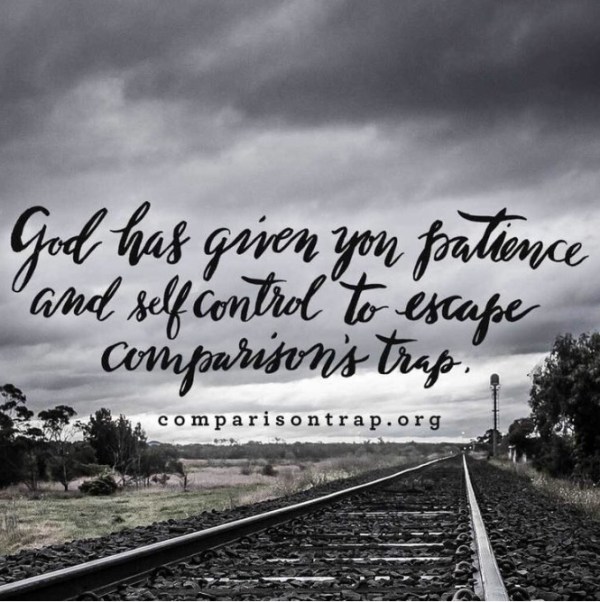
When we find ourselves wanting to be a 10-bagger or lifting our chin in pride at the one-bagger, we can recognize how we’ve fallen into the comparison trap. But through our verse and through our reading, Sandra reminds us that God has already richly equipped us with all the very incredible gifts we need to escape this trap.

Somewhere within us, we have a Spirit of love, joy, peace, patience, kindness, goodness, faithfulness, gentleness and self-control, giving us the ability to take captive the thoughts of comparison. When we do, we grow.


Can I Fathom How to Measure the Immeasurable?

CT.2-7
Photo and artwork belong to ComparisonTrap.org

This is the continuation of an earlier post about a Bible study in which I’m facilitating and participating.


Now to him who is able to do immeasurably
more than all we ask or imagine,

according to his power that is at work within us,
to him be glory in the church and in Christ Jesus
throughout all generations, forever and ever! Amen.
~ Ephesians 3:20-21

The Comparison Trap:  Week Two, Day Seven … Some of my reminders and my takeaways from the daily devotional include:

What I read is that He can do “immeasurably more” than all we ask or imagine.

What is immeasurably more?
How does one quantify that?
What does that look like?

It’s beyond what we’re capable of fathoming, asking for or thinking, but how does that translate to my life? It’s really hard to know when it can’t be conceived.

And that BIG stuff He can do? … He accomplishes it “according to his power that is at work within us.” That’s the Holy Spirit.

God within us.
In me.
In you.
God, who is living, breathing, dwelling and working within us.

And when He does it?He gets the glory. And, he gets it for another amount of time that we can’t really quantify, either.

I really don’t know if I can fully understand how HUGE this concept is. It’s the idea that through His power, He can do anything and everything beyond what I can imagine and that when He does, it will bring glory to Him for all of eternity future. And … He can use ME to accomplish that.

(That’s not arrogance speaking. It’s just me trying to fully realize what He’s saying in His Word. He’s saying the same thing about you.)

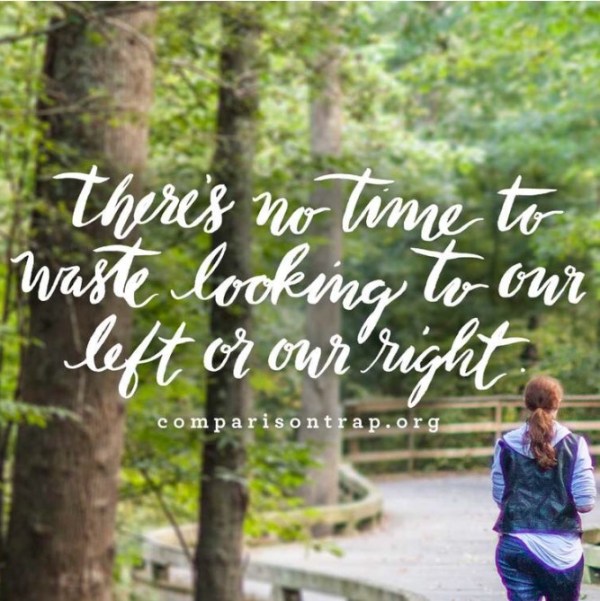
Why is it that I bother looking to the left or to the right to compare myself with others? Why do I  allow myself to feel that I fall short of her?  Why does my pride get in the way of thinking that I might just be a tad better than she is? Why do I  look left and right, when all I really need to do is look up?

Please don’t miss the enormity of this.

Sandra closes the devotional with, “… when God accomplishes more than we can dream, we can watch him get the glory.”

He can, and He will.
But we have to start looking up and stop looking around.